
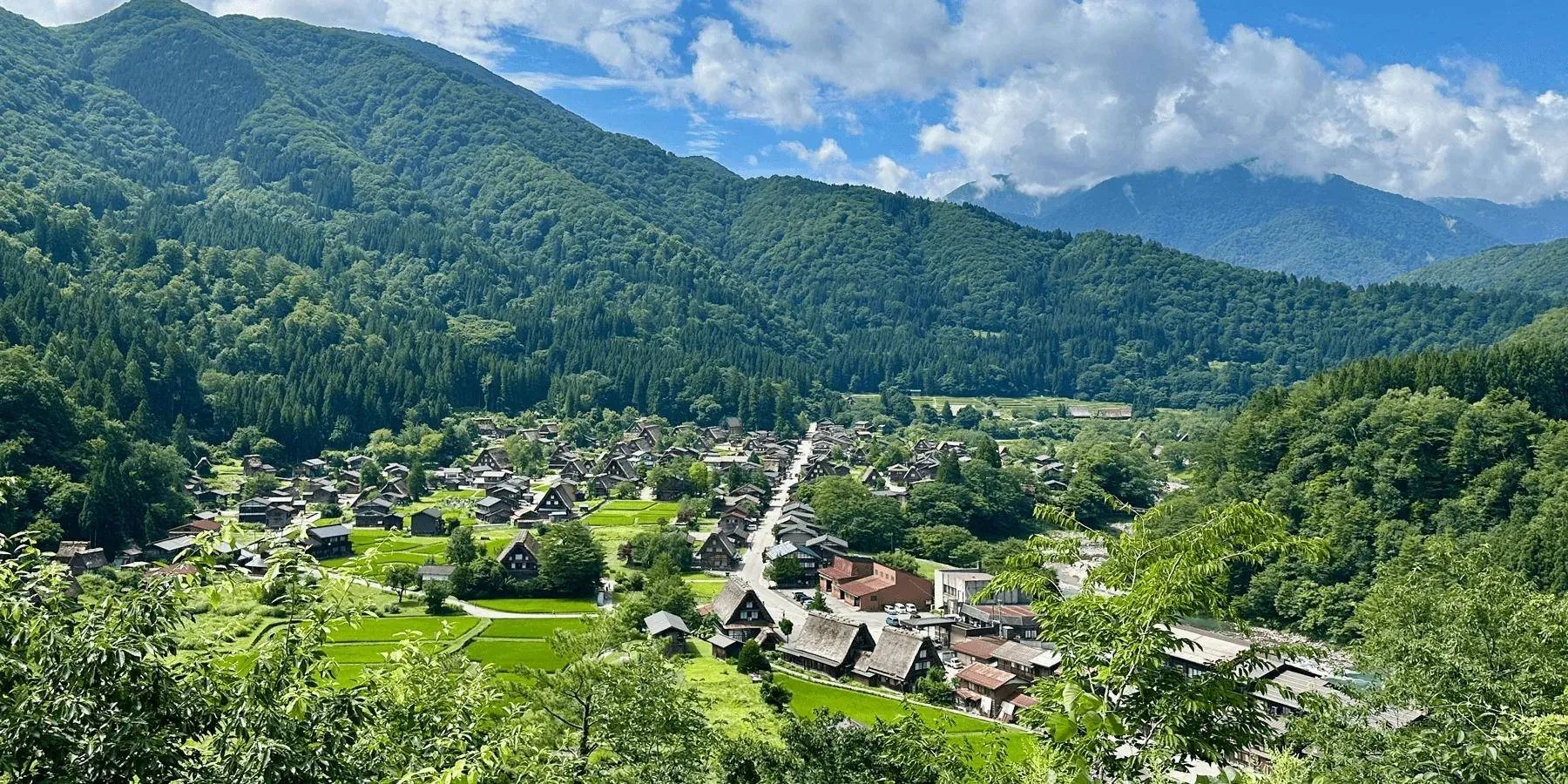
Deep in the mountains of Gifu Prefecture, two destinations offer remarkably different encounters with traditional Japan. Takayama invites visitors to explore an extensive historic district filled with wooden merchant houses, shops, and restaurants. Shirakawa-go presents something far less familiar: an extraordinary mountain village of enormous thatched-roof farmhouses that looks almost too beautiful to be real.
Although the two destinations are close enough to visit on the same day, each has a distinct appeal. Takayama is a living historic town, where traditional architecture blends naturally with shopping, dining, and everyday activity. Shirakawa-go feels more like a scene from a storybook, with steeply pitched roofs, picturesque gardens, and stone-lined waterways set against forested mountains.
Together, they make an excellent introduction to the Hida region. For travelers with limited time, however, understanding what makes each destination special can help determine which deserves priority.
Takayama: An Entire Neighborhood of Historic Streets
Many traditional towns in Japan are known for a single picturesque street. Takayama offers something more extensive.
Its beautifully preserved Sanmachi district spreads across several streets, creating a neighborhood where visitors can wander between traditional wooden merchant houses, narrow lanes, and distinctive lattice-fronted shops. Turning a corner often reveals another attractive streetscape, making exploration more rewarding than simply following one main road.
The buildings reflect Takayama's history as a prosperous merchant town. Today, many contain shops, cafes, restaurants, and sake breweries, allowing visitors to experience the historic atmosphere while enjoying local culture.
Food is another reason to linger. Hida beef is a regional specialty, served in everything from substantial restaurant meals to convenient street snacks. Traditional sweets, local crafts, and sake provide additional opportunities to explore.
For a hands-on cultural experience, a Zen calligraphy session at Takayama's Zenkoji Temple offers a peaceful break from sightseeing. Participants learn traditional brush techniques, grind their own ink, and practice writing Japanese kanji with personalized guidance. No previous experience is necessary, and visitors can take home a unique souvenir of their time in Takayama.
Allow approximately three to four hours for the historic district, including time for shopping, photography, and refreshments. Travelers interested in understanding the town's architecture and history can consider a guided walk through Takayama's historic streets.
Unlike a museum with a prescribed route, Takayama is best enjoyed at a relaxed pace, allowing its streets and shops to guide the experience.
Shirakawa-go: A Village That Seems Almost Unreal
Shirakawa-go makes an extraordinary first impression. Its enormous thatched-roof houses rise from a landscape of gardens, fields, and mountains, creating scenery that seems closer to a beautifully illustrated storybook than an ordinary village.
The houses are surprisingly large, and their scale becomes even more apparent when approached on foot. Their steep triangular roofs, some several stories high, dominate the landscape while blending beautifully with the surrounding countryside.
The village of Ogimachi is part of the UNESCO-listed Historic Villages of Shirakawa-go and Gokayama, recognized in 1995 for their distinctive gassho-zukuri architecture and traditional rural settlements.
Gassho means hands joined in prayer, describing the shape of the sharply pitched roofs. The design is particularly suited to the region's heavy snowfall, allowing snow to slide off more readily.
Yet the architecture is only part of Shirakawa-go's appeal. Small stone paths connect the houses, gardens bring color to the landscape, and stone-lined irrigation channels carry water through the village. Carp can sometimes be seen swimming in these waterways.
The result is a remarkable combination of architecture, landscape, and traditional village life. Almost every direction offers another attractive view, whether of a farmhouse framed by mountains or a quiet path beside a garden.
For a broader impression of the village and its attractions, the Shirakawa-go one-day travel video provides a useful visual introduction.
Inside the Farmhouses: Extraordinary Traditional Engineering
The beauty of Shirakawa-go's farmhouses is immediately apparent from outside, but their interiors reveal an equally fascinating story.
Stepping inside one of the historic buildings exposes the enormous timber framework supporting the roof. Massive columns, beams, and carefully joined wooden members form an intricate structure beneath the thick layers of thatch.
The upper floors are particularly impressive. These spacious areas were traditionally used for activities such as silkworm cultivation, an important part of the local economy. The unusual roof design provided substantial usable space while helping the buildings cope with the mountain climate.
Another distinctive feature is the darkened timber and roof structure. Smoke rising from traditional indoor hearths helped discourage insects and protect the natural building materials, gradually leaving the wood with its characteristic dark appearance.
Several houses open to visitors contain extensive collections of historical tools, farming equipment, household objects, and other artifacts. These displays reveal how families worked, maintained their homes, and adapted to life in a region with long, snowy winters.
Unlike many conventional museums, the opportunity to move through these substantial wooden interiors creates a particularly immediate impression of traditional rural life.
Wada House, Kanda House, and Nagase House are among the historic buildings that visitors may be able to enter. Opening arrangements and admission charges should be checked before visiting.
Exploring at least one farmhouse interior is strongly recommended. The engineering, craftsmanship, and historical displays add an entirely new dimension to the village experience.
Finding the Best Views of Shirakawa-go
Shirakawa-go is one of those rare destinations where beautiful photographs can be taken from almost any angle.
The village's famous observation area provides an elevated panorama of Ogimachi, revealing how the traditional farmhouses fit into the surrounding mountain landscape. It is an excellent place to appreciate the village as a whole and capture a postcard-style photograph.
However, reaching the viewpoint requires additional time. Depending on the itinerary, visitors may prefer to spend those minutes exploring the streets and historic buildings instead.
At ground level, the photographic opportunities are equally rewarding. The enormous roofs create dramatic compositions, while gardens, stone paths, irrigation channels, and traditional fences provide attractive foreground details.
The village changes considerably with the seasons. Spring brings fresh greenery and blossoms, summer surrounds the houses with lush vegetation, autumn adds colorful foliage, and winter transforms the landscape with snow.
For visitors with two or three hours available, exploring the village and entering a farmhouse should take priority. The observation area is a worthwhile addition when time permits, rather than an essential stop.
Remember that Shirakawa-go remains a residential community. Stay on public paths, respect private property, and avoid entering gardens or residential buildings that are not open to visitors.
Planning a Visit to Takayama and Shirakawa-go
Takayama and Shirakawa-go can be combined into a single day's sightseeing, although a more relaxed itinerary allows visitors to appreciate both destinations fully.
Takayama's historic district deserves approximately three to four hours, especially for travelers interested in browsing shops, sampling regional food, and exploring the side streets.
For Shirakawa-go, allow at least two to three hours. This provides time to walk through Ogimachi, enjoy the scenery, and explore one or more historic farmhouses. Photography enthusiasts and visitors interested in architecture may wish to stay longer.
Express buses connect Takayama with Shirakawa-go in approximately 50 minutes. Some services require reservations, and popular departures can fill up during busy travel periods. Current timetables and booking arrangements are available through the official Shirakawa-go access information.
Shirakawa-go has no railway station, so visitors using public transportation will need to travel by bus. Travelers arriving by car should use designated visitor parking areas and allow extra time during weekends and holidays.
Staying overnight in Takayama provides a particularly convenient base for exploring the region. Visitors can enjoy its historic streets without rushing and devote a separate morning or afternoon to Shirakawa-go.
Those preferring an organized excursion can also consider a private tour combining Shirakawa-go and Hida Takayama.
Whatever the itinerary, comfortable walking shoes are advisable, and winter visitors should prepare for cold temperatures, snow, and potentially slippery surfaces.
Other Places to Explore in the Hida Region
Travelers with additional time can discover several other historic destinations in the surrounding region.
Hida-Furukawa, a short train journey from Takayama, offers traditional streets, white-walled storehouses, and picturesque waterways. Its quieter atmosphere makes it an attractive alternative for visitors interested in exploring another historic town.
Gokayama, in neighboring Toyama Prefecture, provides a particularly interesting comparison with Shirakawa-go. The villages of Ainokura and Suganuma share UNESCO World Heritage recognition with Ogimachi and preserve their own collections of traditional gassho-zukuri houses.
The Ainokura village video offers a glimpse of this remarkable mountain settlement.
Within Shirakawa-go itself, the Gassho-zukuri Minkaen Open-Air Museum provides another opportunity to explore historic buildings and learn about traditional rural life.
These additional destinations are best considered when spending more than one day in the region. Takayama and Shirakawa-go already provide plenty to discover without trying to fit too many stops into a limited schedule.
Takayama or Shirakawa-go: Which Should You Choose?
Takayama and Shirakawa-go are both exceptional destinations, but their appeal is quite different.
Takayama stands out for the scale of its historic district. Rather than a single picturesque street, visitors can explore an extensive neighborhood of traditional architecture, shops, restaurants, and local culture. It is especially rewarding for those who enjoy wandering through historic towns at a leisurely pace.
Shirakawa-go offers something more unusual.
Its enormous thatched-roof farmhouses, remarkable interior structures, beautiful gardens, waterways, and mountain setting combine to create an experience that is difficult to compare with anywhere else in Japan.
The village is breathtaking from a distance and even more impressive up close. Entering one of the historic houses reveals craftsmanship and ingenuity that photographs alone cannot communicate.
For travelers who have enough time, visiting both destinations is highly recommended. They complement each other beautifully and reveal different aspects of Japan's architectural and cultural heritage.
But if the itinerary allows only one, Shirakawa-go deserves priority.
Takayama is a wonderful historic town. Shirakawa-go is an extraordinary place unlike almost anywhere else.
Frequently Asked Questions
Can Takayama and Shirakawa-go be visited in one day?
Yes. The two destinations are connected by express bus, taking approximately 50 minutes each way. Allow three to four hours for Takayama and two to three hours for Shirakawa-go, plus transportation time.
Is Shirakawa-go worth visiting without going to the observation area?
Absolutely. The village offers beautiful scenery at ground level, and exploring the streets and historic farmhouse interiors provides a deeper experience than the panoramic viewpoint alone.
Can visitors enter the traditional farmhouses?
Yes. Several historic houses, including Wada House, Kanda House, and Nagase House, welcome visitors. Admission charges and opening arrangements vary.
Which destination is better for traditional architecture?
Both are excellent, but they offer different experiences. Takayama is known for its preserved wooden merchant houses and historic streets, while Shirakawa-go is famous for its enormous gassho-zukuri farmhouses and distinctive thatched roofs.
What is the best season to visit?
Both destinations can be enjoyed throughout the year. Spring and summer offer greenery, autumn brings colorful foliage, and winter creates particularly dramatic snowy scenery in Shirakawa-go. Winter travel requires additional preparation for weather and road conditions.